Case study 01 · Prove AI · 2026

The marketing team runs itself now

Over six months I used AI to build the tooling and the loops that take the tedium out of our marketing week. It replaced the platform we rented and the outside team we paid to drive it, taking more than $130,000 a year out of the budget and turning a multi-week round trip into about two days, so our own people spend their time deciding what to say instead of briefing somebody else to say it. The decisions I'm proudest of are the places I stopped it.

Role
Creative Director, built it myself
Built
Six months, alongside the day job
Scope
Website · Content · Video · Analytics
Replaced
A platform subscription and an agency retainer
Stack
Next.js · Claude skills · HyperFrames

The setup

What the week used to cost

Before this, marketing ran on a rented platform with an outside team paid to drive it. Every post, every email and every landing page went out through people who had to be briefed, scheduled and waited on.

A new page went like this. We would iterate on the design internally for a couple of weeks, hand it over, meet about it, and wait. A week later a version came back. We would review it, ask for the changes, and wait again: a few more days, sometimes another week. Then, maybe, we launched.

Nothing was wrong with the work. The problem was the shape of it. A small in-house team spent most of its week describing what it wanted to somebody else instead of making it, the calendar was set by other people's availability, the bill arrived whether we shipped anything or not, and every question we wanted to ask a design cost a fortnight to ask it.

The system

How the week runs now

One week of the marketing system Six beats in a clockwise weekly cycle. Monday morning the scrub and the analytics run automatically. Monday afternoon the team meets and picks the week's angle. Copy and imagery follow, then the post is published, emailed, and later in the week turned into video for social. Skills and context sit at the centre, feeding every beat. Each beat links to its own section below. Skills & context loaded before any beat starts a person automatic Monday, 9am the scrub and the numbers news · reddit · last week's analytics lands in Slack, so the room arrives read up Monday, 2pm standup the team picks the week's angle Tuesday write and curate the post, the email, and the imagery Midweek publish brief → skills → Vercel, nothing missed Same day the email sends itself written Tuesday, scheduled since Later that week video, out to social driving back to the post One week of the marketing system The same six beats read top to bottom across a week, from Monday's automated scrub through the team's Monday standup, writing, publishing, email and video, with a return path back to the following Monday. Skills & context person auto Monday, 9am scrub + numbers news, reddit, numbers → Slack Monday, 2pm standup the team picks the angle Tuesday write and curate post, email, imagery Midweek publish brief → skills → Vercel Same day the email sends itself written Tuesday, scheduled since Later that week video, out to social driving back to the post And the numbers start it again
Plate 01

One week, on repeat. The machine does the gathering and the mechanics; the two filled beats are the ones a person still owns. Monday morning the scrub and last week's numbers land in Slack together, so the standup starts with a room that has already read them. Every beat below is one of these, opened up.

Monday, 9am · automatic

Three reports, before anyone opens a laptop

The weekly scrub reads the past week of AI and agent news and scores every story against what the company actually claims. Not "is this interesting" but "can we say something true about this." It comes back as a dated digest of five to eight stories with the angle already drafted against each one.

Alongside it, a Reddit scanner sweeps the engineering, finance and legal subreddits for threads worth joining, and throws out the vendor marketing that makes up most of the volume. And the analytics job pulls last week straight from the source APIs, computes it locally, and renders a dashboard in the brand's own styling.

All three land in Slack on a schedule. Nobody runs them, and nobody chases them. By the time the meeting starts the whole team has read the same three things.

Where it stops

The scanner never posts. It produces a shortlist and a person writes every single reply, because the moment a brand automates conversation it stops being one.
Monday, 2pm · a person

The half hour everything else exists to serve

Short, on purpose. Everyone arrives having read the same reports, so the meeting is not a briefing. It is an argument about what we should say this week, and it ends when one angle wins.

That is the entire output of this beat: a decision. Every automated thing upstream exists to make it a good one, and every automated thing downstream exists so that acting on it costs almost nothing.

Tuesday · a person

Written against the system, not corrected after it

Copy gets drafted, the email gets drafted alongside it, and design curates the imagery. What makes this fast is that the brand rules are not a document somebody has to remember to open. They are skills the model loads before it writes a word.

There are five: brand and design tokens, the company and its product, voice, content design, and long-form craft. They are version-locked by content hash, so a skill cannot drift without the change being visible. Above them sits an index that loads only the sections a task actually needs, and states plainly which source wins when two of them disagree.

It is the same job as the guidelines that kept fifty thousand AARP pages coherent, and the hundred-and-forty-four page book JKR wrote for Casper. The difference is only that this one is written to be obeyed rather than remembered.

Where it stops

Enforce at generation, not at review. Brand compliance used to be a thing you caught in the second round. Loaded before the work starts, that cost goes to zero and the policing leaves my week.

Midweek · automatic

A document becomes a designed page

A doc and a cover image go in. A published page comes out, deployed straight to production.

A playbook governs what happens in between, and the important idea in it is that a post is not markup. It is metadata plus an ordered list of typed blocks, so structure is data rather than a decision re-made on every post. Three or more headings earns a sticky contents rail and a reading-progress bar; fewer, and it stays a single clean column. The share card is generated. Type, spacing and colour come from the same tokens the product uses.

None of that is judgment. It is the accumulated set of things a careful designer would check, written down once so nobody has to hold them in their head on a Wednesday.

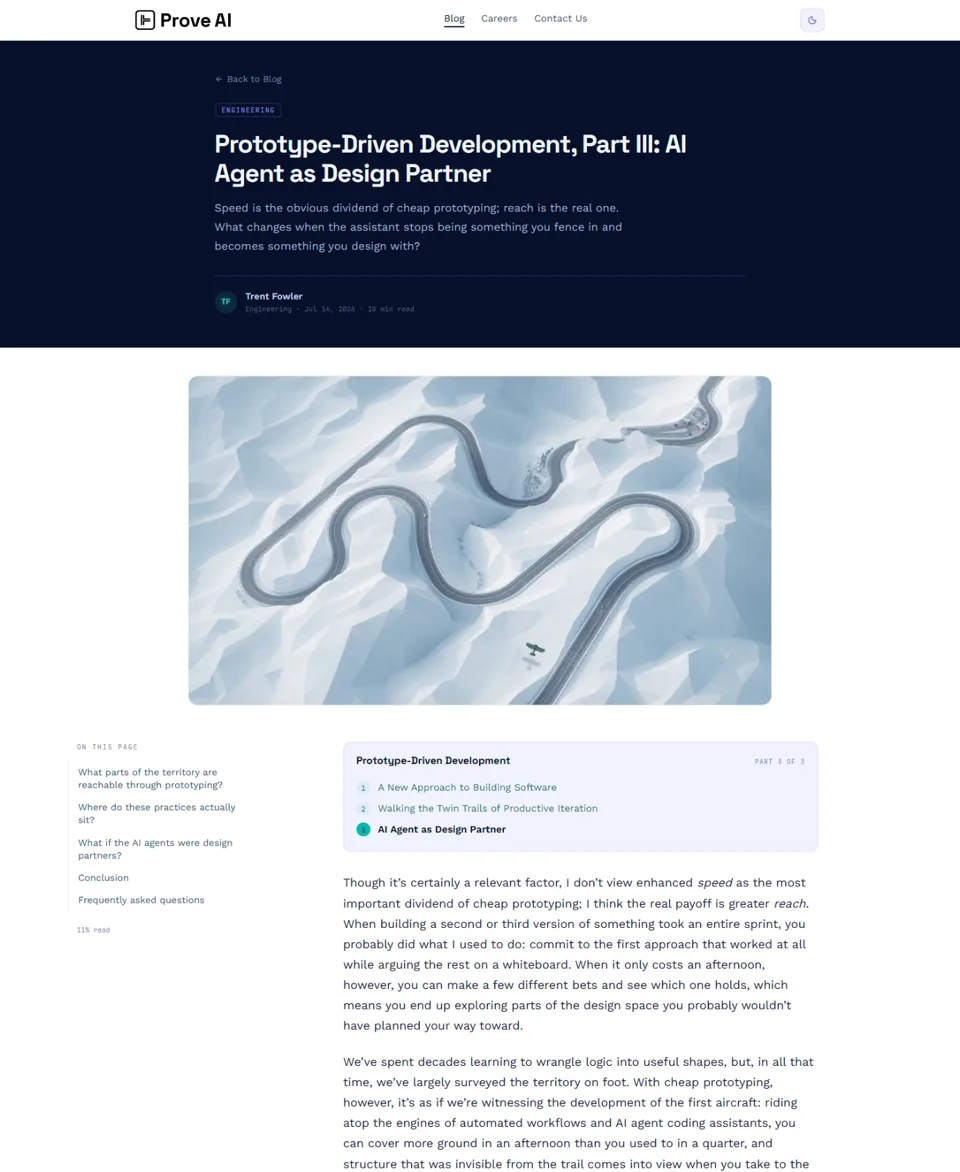
A published Prove AI blog post: category tag, title, deck, byline with read time, hero image, a contents rail with reading progress, a three-part series navigator, and the body copy
Plate 02

What comes out the other end. The contents rail and its reading counter appeared because the post cleared three headings. The series navigator, the byline, the read time and the share card were all assembled from the metadata rather than placed by hand.

Same day · automatic

The email sends itself

Written on Tuesday by a person, scheduled, gone. The only thing automated here is the clock, and that is worth saying out loud, because it is the difference between a system that writes your email and a system that remembers to send it.

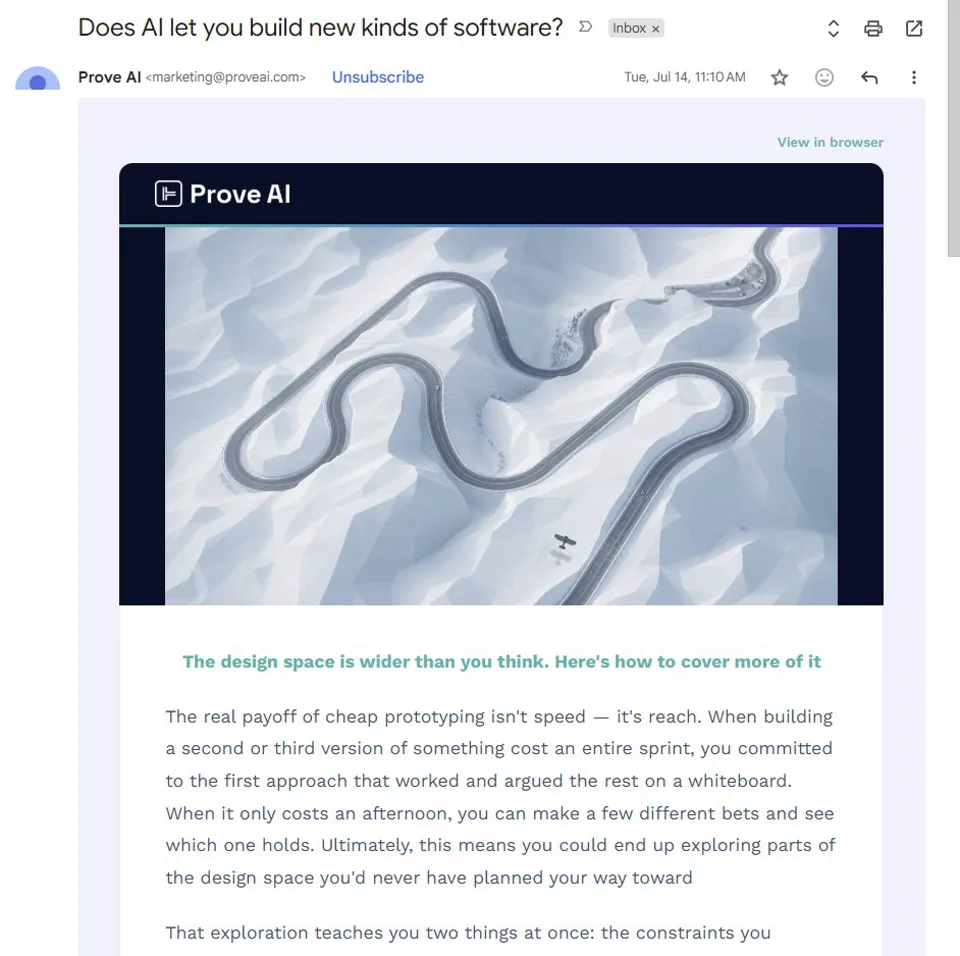
The same post as a Prove AI marketing email, landed in an inbox: branded header, the post's hero image, the deck and the opening paragraphs
Plate 03

The same post, an hour later. Same hero image, same opening, cut down to what earns a click in an inbox. One Tuesday's work reaching two surfaces.

Later that week · automatic

The post becomes social

One link in. A skill distils the published post into a seven-beat editorial script, ElevenLabs lays down the narration and a music bed with word-level timing, and HyperFrames composes the motion graphics in HTML and GSAP, syncing every frame to that timing before rendering locally to 16:9, 9:16 and 1:1.

Because the composition is code rather than a timeline, a fourth aspect ratio is a layout swap instead of a re-edit. And because the front end is just another skill, the same spine runs from a press release, a product launch, or a website. Nothing in this was touched in a video editor.

Plate 04

Thirty-five seconds, from one URL. Script, voice, music and every frame of motion, produced from nothing but the address of the post it sends you back to.

Where it stops

The videos send you to the article, never to a sales call. The same stack could produce feature tours and demo pitches. It produces editorial instead, because the job is authority, and the product is better argued for than advertised.

And where it stopped itself

This beat used to include a synthetic presenter, and the team found them uncanny. I would have preferred to let engagement settle it, having been wrong about my own instincts before. But every stage here is a slot rather than a foundation, so we pulled it, the wheel kept turning, and the work shipped that week.

The outcome

What the week costs now

$130K+Out of the annual budget, platform and retainer
Weeks daysFrom a design idea to the page being live
2 of 6Beats in the week that still need a person

The subscription and the retainer are both gone. What replaced them runs on the same machine the design work happens on, so what is left is API calls and hosting.

The bigger change is the clock. A change takes hours now. A prototype is up and testable the same day, and we are agreed on it the next, where the same question used to cost a fortnight to ask. We do not iterate faster so much as we get to iterate at all.

The saving is the part a CFO cares about. The part I care about is that the people who used to spend their week writing briefs for somebody else now spend it deciding what we should say.

None of this replaced anybody on our team. What went away was a subscription and an outside retainer. What the people here got back was the part of the job they were hired for in the first place. If a system like this makes your own team smaller you have built it wrong, or you have built it for the wrong reason.

It is also why pulling the synthetic presenters cost us nothing. When a version takes a day instead of six weeks, being wrong is cheap enough to act on, and you stop defending work just because of what it took to get it made.

There is one number this study does not have, and leaving it out is deliberate. It was never a volume play. Building the machine before you have to lean on it is the entire point: when the moment comes to move at pace, that is a scheduling decision rather than a project, a budget request, or a hiring plan.

Looking back: this is the same job I have always had, which is getting a system to hold its shape without me standing over it. The style guide that kept 50,000 AARP pages coherent did it with rules people had to remember. This one does it with rules a machine cannot forget, and the only real skill is still knowing which rules are worth writing down.