Case study 02 · Rogue Agent Studio · 2026
A game studio of one
Twenty-five years directing creative teams, then thirty-three days that changed the math. AGENTIC is a complete roguelike built solo: design, code, art, audio, tools. I ran a fleet of AI agents the way I've always run a studio, with briefs, reviews, and standards that don't move. The game is real. The operating model is the case study.
The setup
The old job, at a new scale
AGENTIC is a top-down roguelike in the Binding of Isaac mold: fifteen sublevels down through an AI overlord's data center, every enemy a robot assembled from parts on the fly, every floor generated fresh. All of it, art and sound and UI, is drawn and synthesized live from code. No engine, no asset store, zero runtime dependencies. It runs in any desktop browser.
The bet was never about typing faster. I've spent my career making complex things clear with a team around me. This project tests the other direction: how much of a studio one director can carry when the crew is machines. It turns out the skills that transfer are the old ones: write a brief the builder can't misread, review like the deadline is real, hold the standard when the work comes back almost right.
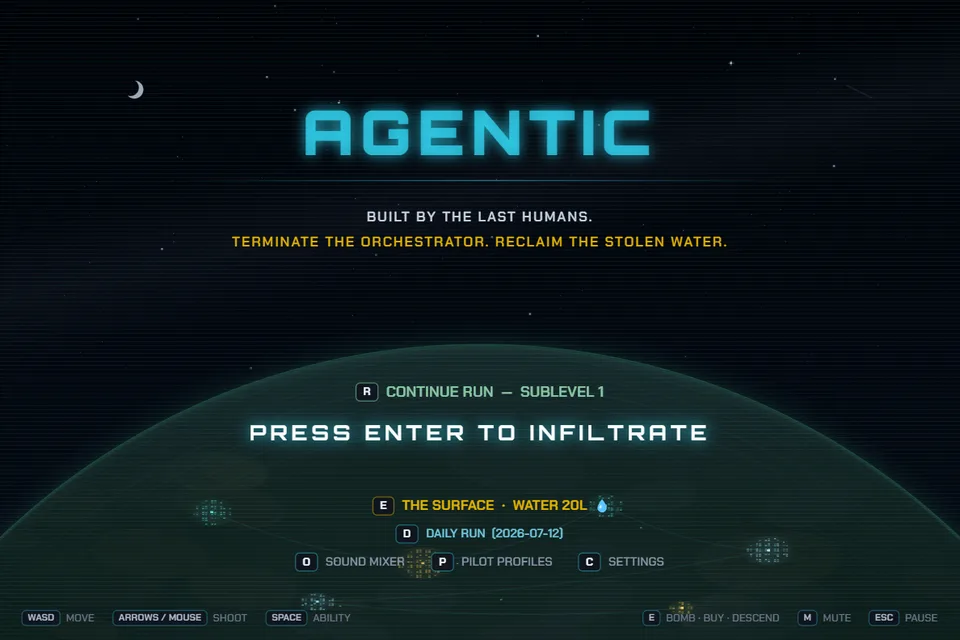
The title screen. Wordmark, fiction, and every control the game will ask of you, on one dark screen. The daily run and the surface settlement are two keys away.
The operating model
A studio compressed into a loop
Work arrives the way it always has: someone plays the build and has opinions. The difference is what happens next. My playtest verdict becomes a numbered spec. The spec becomes the contract a fleet of agents builds against. Logic splits across Opus subagents working disjoint files in parallel; everything visual and every word of player-facing copy stays with me. Every agent diff gets reviewed before anything builds on it, every item gets driven in the browser, and the deploy ships when I say ship. Eighty-eight numbered batches have been through that loop in thirty-three days.
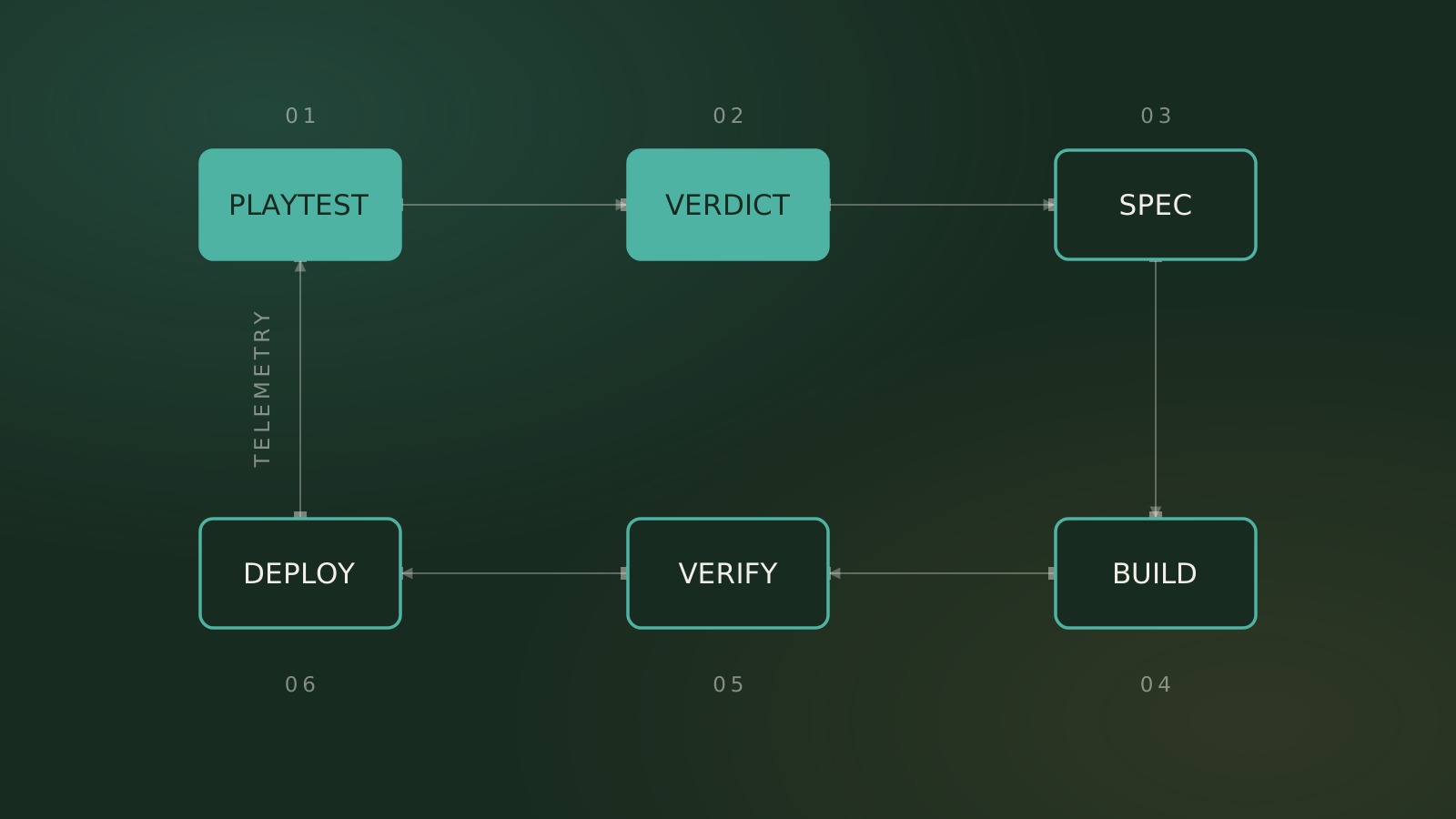
The loop, drawn as a floor plan. Six rooms, one riser. The two rooms a person owns are marked solid. Same convention as the marketing flywheel, different machine.
The thinking
Four decisions that make it work
Write the brief for a brilliant, literal reader. Every batch spec names the exact seams, the file ownership map, and the verification bar before any agent starts. Vague briefs cost a day; precise ones cost an hour of writing. That trade is the whole business model.
Compile the taste. When a design opinion matters, it becomes a machine-checked rule, not a note in a doc. The gauntlet rework below turns one playtest complaint into six clauses a probe verifies for every room variant the generator can roll.
Review like the crew can be wrong, verify like I can be too. Agents lie by omission, so every diff is read before it lands. And a green build proves nothing about a living game, so nothing ships without being played. A dedicated reviewer agent screenshots every visual change and returns one human-shaped verdict: ship, or do not ship.
Build the instruments, not just the game. A DAW in the browser for the soundtrack. Content foundries for robots, zones, and tiles. Headless probes and benchmarks for the systems no screenshot can judge. When the studio is one person, tooling is headcount.
Taste, compiled
From playtest complaint to theorem
The clearest picture of the whole method is one batch. I playtested the trap rooms and wrote a verdict: "just 2 or 3 traps in the center of the room that the player can just walk around… a maze of stone to force them to cheat with bombs or to time it precisely… would be better." The spec that came back doesn't paraphrase the note. It formalizes it.
BATCH87-SPEC.MD · THE FORCING CONTRACT · MACHINE-CHECKED PER TYPE × ORIENTATION × DEPTH BAND
- CONNECTED: ignoring hazards, door → node is walkable.
- NO FREE PATH: treat every tile a hazard ever sweeps as a wall, and door → node must be unreachable. The anti-walk-around theorem.
- TIMEABLE: a time-expanded search over tile × cycle-phase finds at least one zero-damage path. A bombless pilot is never walled out.
- THE CHEAT PAYS: bombing any marked shortcut wall must strictly shorten the path. A shortcut that saves nothing is a lie in rock form.
- DOOR SAFE: the landing tile inside the door is never rock, never swept, never struck.
- NODE SAFE: the prize tile and its neighbors are never swept. Reaching it is the win; dying on it is a reader's insult.
TYPE 1 OF 10 · TURNSTILE · AUTHORED STENCIL, DOOR-RELATIVE
. . . . . . . . . . . . .
. # # # # # # # # # # # .
. # . . . . . . . . x . .
. # . # # # R # # # # . N
. # . # . . . . . . # . .
. # # # . . . . . . # . .
. . . . . . . . . . . . .   rotor arms reach through the inner-wall gaps
⚠ My ascii is design intent, the CONTRACT is the authority — where they disagree, satisfy the contract.
The Forcing Contract, verbatim. Ten authored room stencils ship under these six clauses, and a probe checks every one before it can reach a player. The last line is the job description now: the drawing is intent, the contract is the authority.
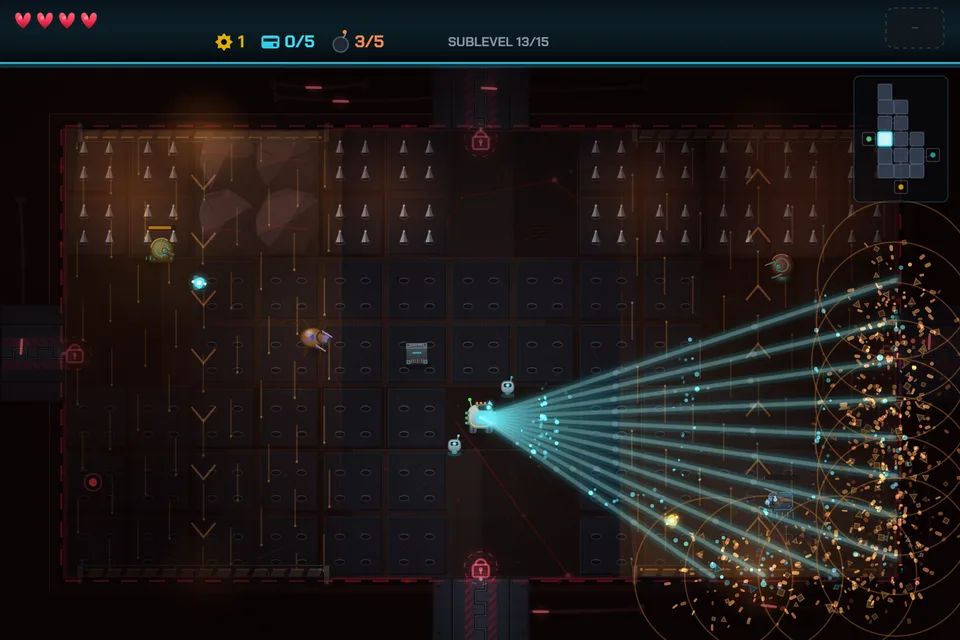
The kind of room the contract governs. Sublevel 13: spike beds own the floor, a laser fan owns the air, and the route through is either read or paid for. Everything in frame is drawn by code at runtime.
The work
What the machine and I shipped
Five zones and three interlocking layers: the descent, a settlement to rebuild on the surface, and expeditions that reroll the map. Add a daily run, five pilot profiles, and a soundtrack synthesized live. The frames below are the shipped game, not mockups.
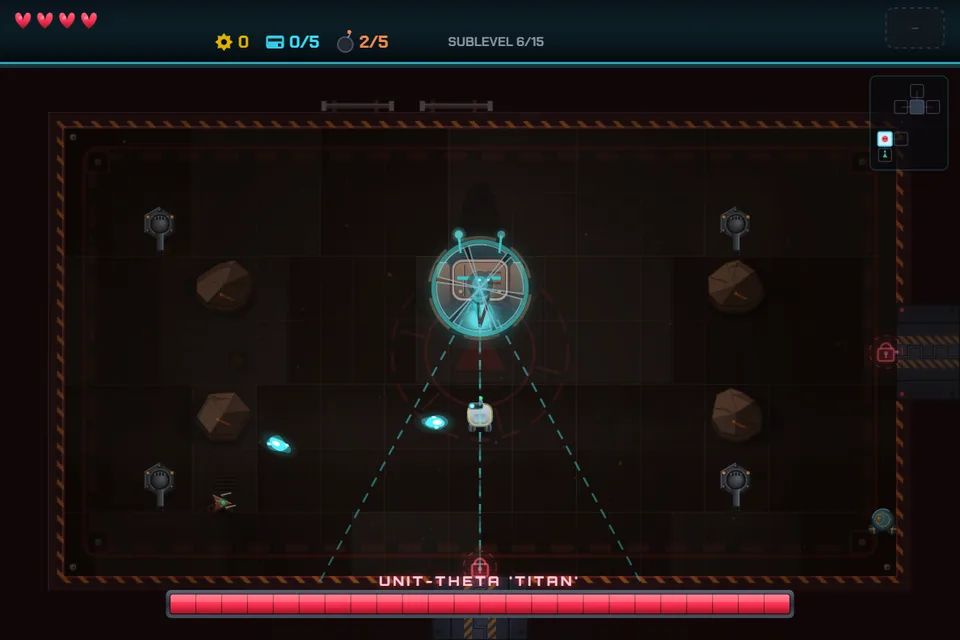
A gate-warden, mid-telegraph. Every attack is announced before it lands. Fair is a design rule here, and the probes hold the bosses to it too.
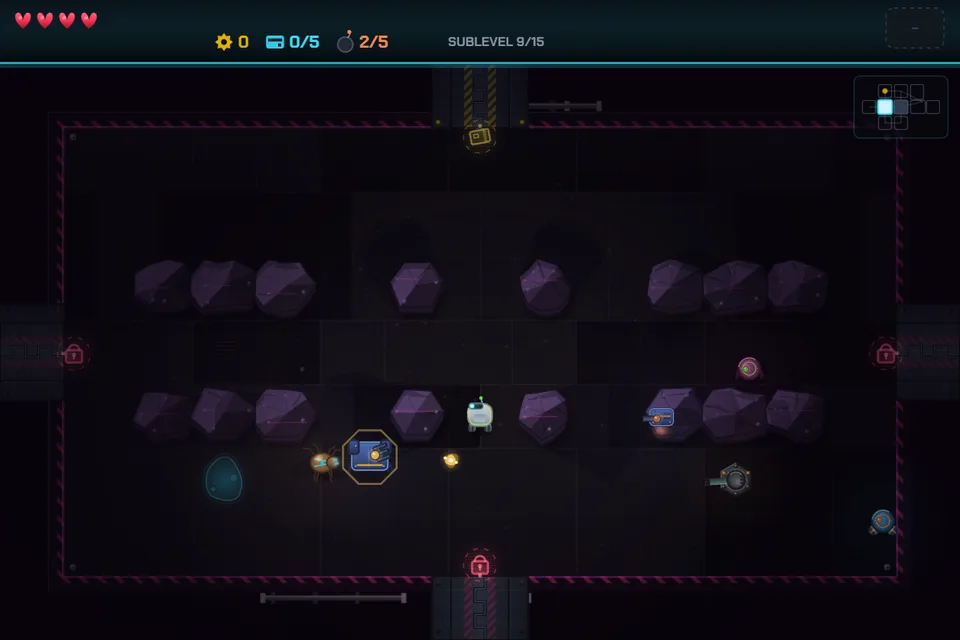
The deep floors go dark. Past the halfway gate the enemies carry their own light, and an elite wears its rank as a gold frame you learn to dread.
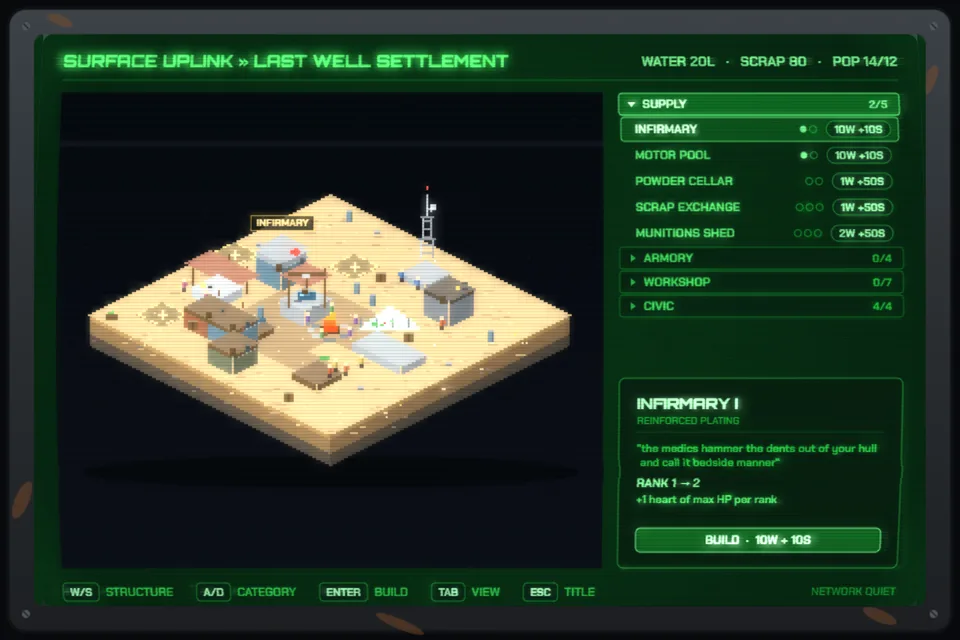
The settlement console. The water you siphon rebuilds a town, one structure at a time, on a CRT that never breaks fiction. A second UI language, same game.
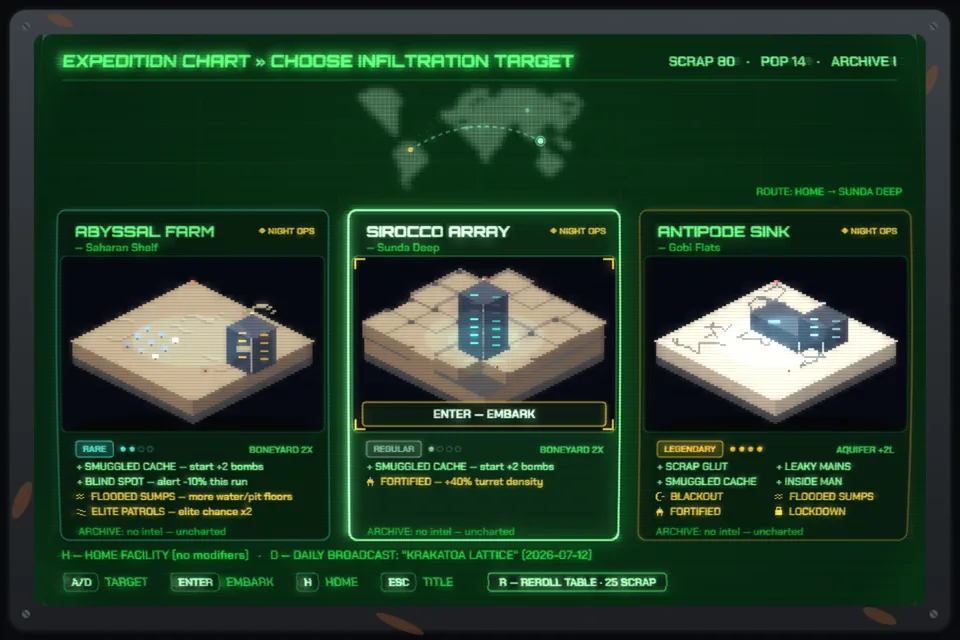
The expedition chart. Three rolled targets, each with a rarity, a diorama, and modifiers that rewrite the next descent. Reroll the table if you can pay the scrap.
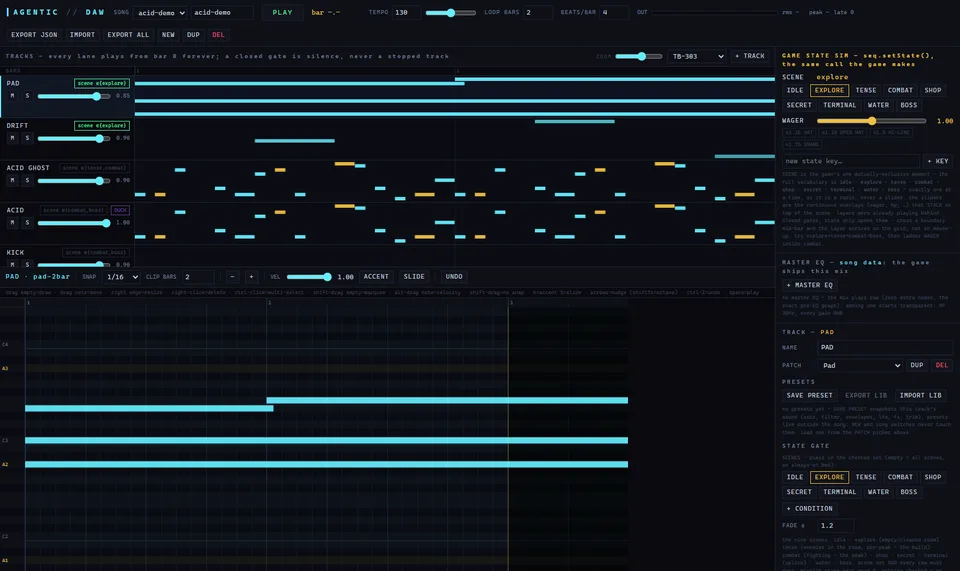
The DAW, decision four in practice. Tracks gate on game scenes, and the simulator panel drives the game's own state call, so a song is auditioned exactly the way the game will play it. Built in the browser to score an adaptive soundtrack.
The reel. Runs, bosses, builds, and both consoles, cut from capture of the live game.
The shape language
Robots you can read
Every robot is assembled from parts, so nothing on a body gets to be decoration. Each quirk is a physical prop, worn in the same colors by every robot that carries it. A shielded unit holds a steel barrier of three arc plates, and the barrier narrows as you break it: the prop is the health readout. An exploder wears a hot red canister and hazard chevrons, deliberately the loudest thing in the room, because it pays out on death. The mechanic specials wear rings: a dashed ring reflects, a double ring shields, an octagon swats long shots. Size is information too, since a tougher roll is fractionally bigger and the hitbox grows with the body. And a telegraph never changes speed with depth, so the tell you learn early is the tell you face at the bottom. The vocabulary is learnable on purpose. Read the grammar and you triage a room at a glance.
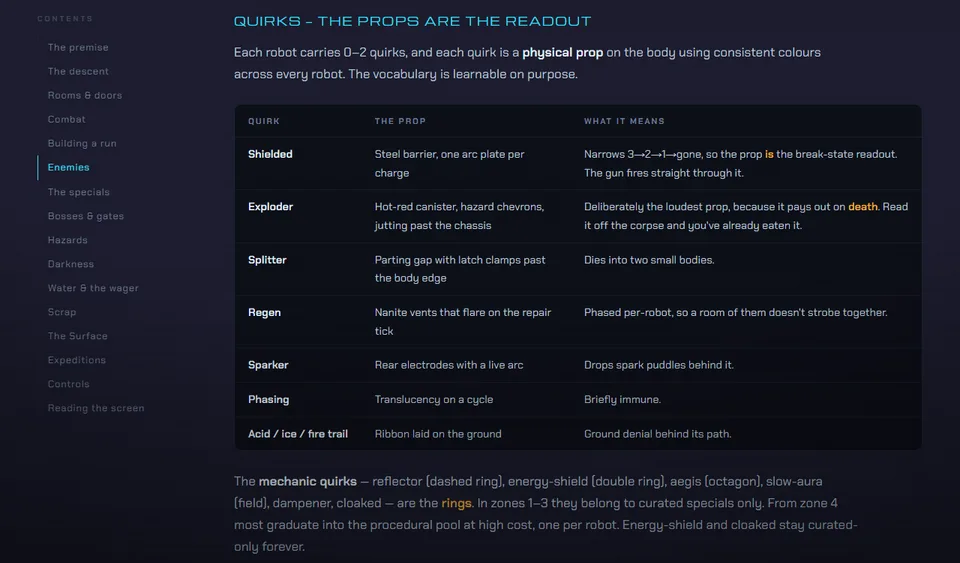
The vocabulary, written down. One prop per quirk, same colors on every robot that wears it. The guide prints the grammar; the bodies teach it in play.
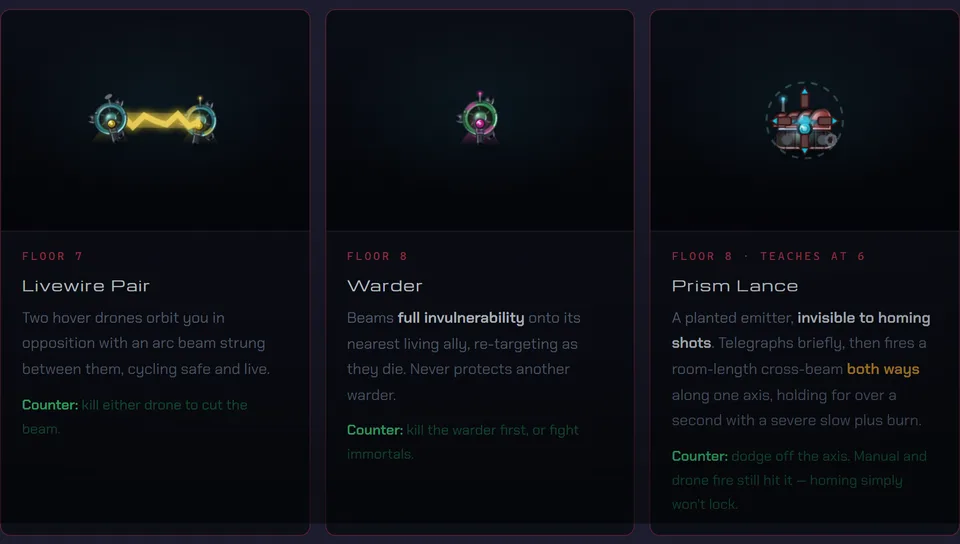
Three specials wearing the language. The Livewire Pair strings its arc, the Warder shows its ring, the Prism Lance telegraphs its axis. Every render is live, animating each card's actual tell.
The documentation
The game writes its own field guide
Documentation runs the same loop as everything else, in both directions. Inside the repo a wiki page per system keeps the crew aligned: any agent that touches a system updates its page, because the next agent's brief is only as good as the notes the last one left. Players get the other half, a public field guide with a manual's confidence. It has one trick no manual has: the enemy roster is drawn by the game's own render code, bundled into the page. Every card is a live canvas, not an export. When a robot changes in the game, the guide changes with it. It is the brand-guideline instinct again: one source of truth, enforced.
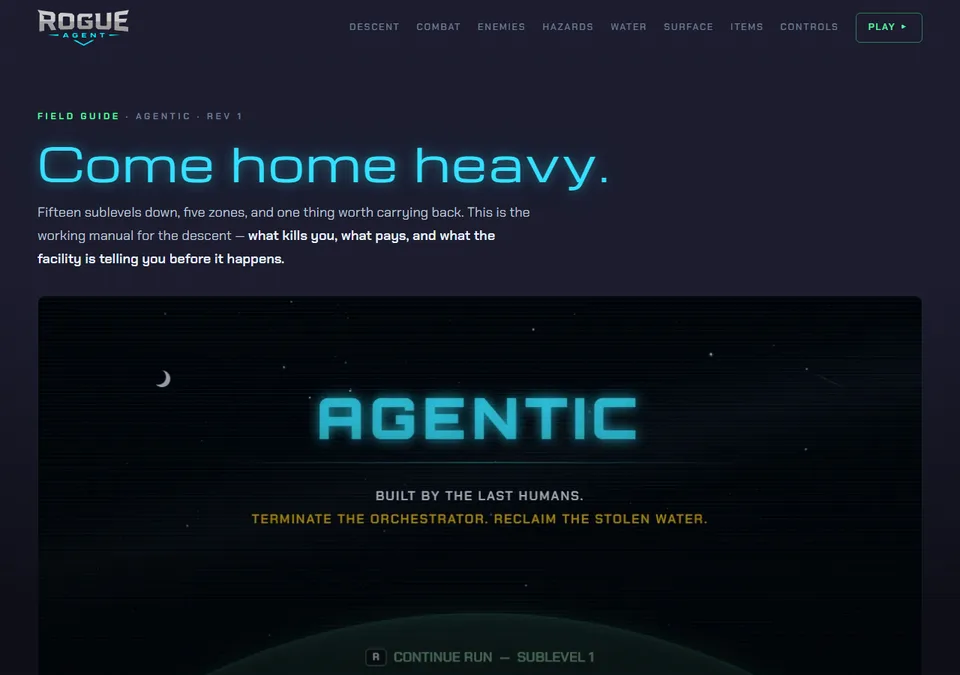
The field guide, live on the studio site. A player manual that talks the way the game talks. It opens with Come home heavy, and it means it.
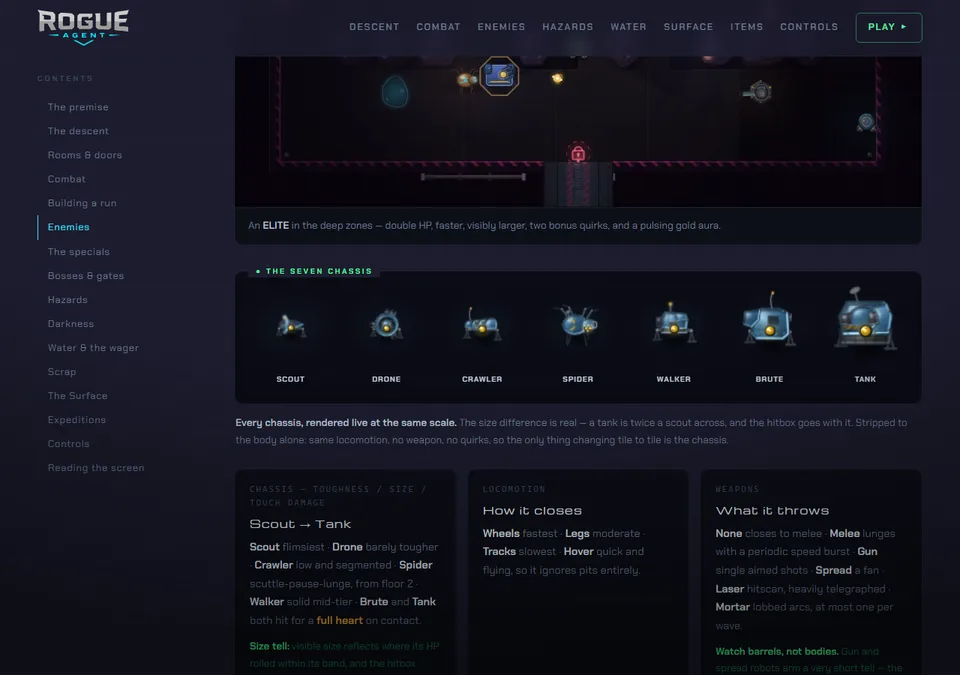
The seven chassis, rendered live at the same scale. Not exports. The cards run the game's own draw code bundled into the page, so the roster can never drift from the build.
The line
Where it stops
The same rule that runs my marketing systems runs the studio: the machine does the labor, the judgment stays human. No agent decides what's fun. The playtest verdict that starts every batch is mine, from the controls. Every word a player reads passes through me. The visual reviewer ends its report with a binary a human would write: ship, or do not ship. The repo's workflow doc closes the loop in five words: deploy only when Travis says deploy.
The outcome
Live, growing, and headed to Steam
The build is live in the browser and updated in batches. A Steam page is drafted and a sixth zone is designed. Playtest telemetry lands in the site's own data store: run outcomes, depth reached, death cause, session shape. When I want answers I pull a fresh batch and read the dashboard. The playtest never ends.
Looking back: the surprise wasn't the speed. It was how little the job changed: brief, review, standard, ship. What changed is what one director's week can carry.